
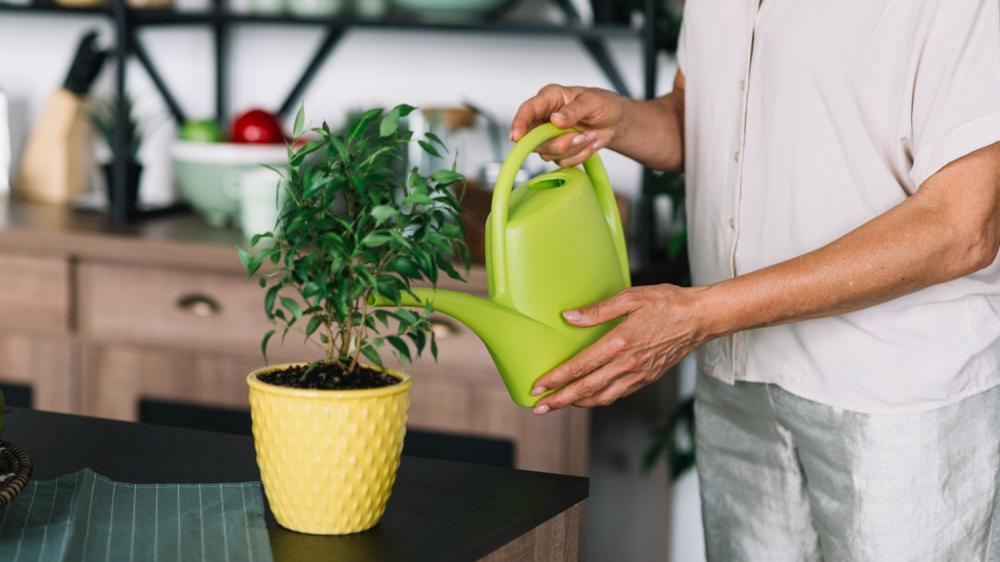
Liquid fertilizer represents a complete meal of vitamins and minerals that the plant needs to grow, flower, and stay healthy. It is the bridge between the demanding nature of the plant and the limited home environment. Therefore, in this comprehensive guide, we will take you on a complete educational journey starting with understanding what liquid fertilizer is and its importance, through how to use liquid fertilizer for indoor plants, to how to choose the right type and avoid common mistakes. We will also highlight a balanced liquid fertilizer as an ideal option for beginners, and provide you with a practical step-by-step guide to correct application, while revealing the mistakes that most plant lovers make and how to avoid them, and why Al-Talib is the ideal choice for buying the best fertilizer for indoor plants.
Liquid fertilizer for indoor plants
Liquid fertilizer for indoor plants is a concentrated nutrient solution that acts as a complete food for plants living in pots inside homes or offices, and is considered as vitamins or nutritional supplements tailored to your plants.
The importance of a balanced liquid fertilizer
A balanced liquid fertilizer contains similar or equal proportions of the three main nutrients, such as nitrogen, phosphorus, and potassium, like the common formulations 10-10-10, 20-20-20, or 15-15-15. Here's the importance of a balanced fertilizer:
- It promotes all stages of plant growth without neglecting any aspect, as nitrogen nourishes the leaves and stems (vegetative growth), phosphorus strengthens the roots and stimulates flowering, while potassium promotes overall health and resistance.
- Preventing unbalanced growth when using unbalanced fertilizers and producing plants with consistent growth.
- One solution that suits most needs and is ideal for beginners or those who own a variety of plants.
- A balanced concentration means that the risk of over-concentrating on one element and burning the plant is lower, and it can be used with greater confidence according to standard dilution guidelines.
- It adequately supports all stages of growth, even if it is not absolutely optimal for each stage, and does not conflict with the plant's natural life cycle.
- It encourages strong root growth with phosphorus support, healthy leaf formation with nitrogen support, and a stress-resistant plant with potassium support.
- It prevents the appearance of common signs of nutrient deficiency, such as yellowing of old leaves, stunted growth, delayed ripening, burnt leaf edges, and weakened resistance.
How to use liquid fertilizer for indoor plants
Here's how to use liquid fertilizer for indoor plants, step by step:
Choosing the right time
- Spring and summer (the active growing season) is the ideal time for regular fertilization.
- The best time is early morning or sunset.
- Do not fertilize a stressed plant, whether it is wilted, diseased, or newly planted.
Checking environmental factors
- Plants in shaded areas need less fertilization.
- Avoid fertilizing at extreme temperatures, whether very high or very low.
Read the instructions carefully
- The standard ratio is often ½ - 1 teaspoon (2.5-5 ml) per liter of water.
- It is always recommended to follow the manufacturer's specific guidelines.
Preparing the solution
- Use lukewarm water, not cold.
- First, fill the watering can with water.
- Add the specified amount of fertilizer and stir well until fully mixed.
Water the plant before fertilizing
- Water the plant with plain water until the soil is moist.
- This prevents root shock and ensures even distribution of fertilizer.
actual fertilization
- Water the plant with the fertilizer solution slowly and evenly.
- Stop when water starts to come out of the drain holes.
- Do not leave water in the saucer of the pots for more than 30 minutes.
Post-fertilization
- Move the plant away from direct sunlight for a few hours.
- Make sure the place is well ventilated.
Types of liquid fertilizer for indoor plants
Choosing the best fertilizer for indoor plants is a combination of science and art. Plants don't need intensive fertilization, but rather smart and regular fertilization. Here are the types of fertilizers for indoor plants:
- Balanced fertilizers feature an equal NPK composition such as 10-10-10, 20-20-20, are suitable for most indoor plants, are ideal for beginners, and provide comprehensive nutrition suitable for general foliage plants, pothos and ivy.
- High nitrogen fertilizers stimulate vegetative growth and enhance green color, and are suitable for leafy plants such as ferns and ornamental leaf plants.
- High phosphorus fertilizers stimulate flowering and fruiting, strengthen roots, and are suitable for flowering plants such as African violets and orchids.
- Specialized citrus fertilizers with a calcium-free formula that also contains chelating elements and are suitable for oleander, gardenia and indoor citrus plants.
- Liquid organic fertilizers are characterized by being natural and safe, improving soil structure, and providing a slow release of nutrients, such as DCW seaweed extract, 1 kg pack, available from Al Talib Store.
Common mistakes when using liquid fertilizer for indoor plants
There are some common mistakes in the way liquid fertilizer is used for indoor plants; here are some of them:
- Over-fertilizing is the most common and dangerous mistake because increasing the dose does not give better results. Indoor plants need much less than outdoor plants. Signs of over-fertilization include brown and burnt leaf tips, white crusts on the soil surface due to salt accumulation, leaf drop, and cessation of growth despite care, in addition to a foul odor from the soil as a result of root decomposition.
- Fertilizing at the wrong time and fertilizing plants during their dormant period prevents the plant from absorbing nutrients, leads to fertilizer accumulation and root burns, and weakens the plant instead of strengthening it.
- Fertilizing a stressed or sick plant and treating a sick plant with fertilization as a treatment, as fertilization increases the burden on weak plants, since a stressed plant cannot process nutrients.
- Failure to moisten the soil before fertilization and placing fertilizer on completely dry soil causes direct chemical burning of the delicate roots and uneven absorption of nutrients.
- Using unsuitable water for dilution, such as using very cold water, using hard water rich in minerals with fertilizers, or using freshly chlorinated tap water.
- Mixing different types of fertilizers to obtain a stronger formula causes unexpected chemical reactions, increases the toxic concentration of some elements, and damages the effectiveness of the components.
Why choose Al Talib Store to buy liquid fertilizer?
Al-Talib Store is not just a place to buy products, but a true partner in your journey with the best fertilizer for indoor plants. Here's why you should choose Al-Talib Store to buy liquid fertilizer and learn more:
- We have specialized, family-oriented experience and a support team of indoor farming experts.
- We test every product before offering it and we keep up with the latest technologies in fertilization.
- A variety that meets all needs, providing easy-to-use fertilizers and a specialized range according to plant type.
- We accurately determine the needs of your plants and formulate a customized formula that suits the plant's needs.
conclusion
Together we have explored the world of the best indoor plant fertilizer, from understanding its nature and importance, to mastering the proper use of liquid fertilizer for indoor plants, to avoiding common mistakes and choosing the right products. But remember that true knowledge begins when you apply what you have learned in practice, and that the growth of your plants is not the end but the beginning of a deeper journey in the world of indoor gardening. So continue to learn, experiment, and observe, share your successes with others, consult when needed, and know that Al-Talib Store remains your constant partner on this journey, always ready to support you with its expertise and the quality of its products. So do not hesitate and contact us to get the best indoor plant fertilizer through the WhatsApp social networking site.
Frequently Asked Questions
1. How often should I water my indoor plants with liquid fertilizer?
During the active growing season (spring and summer) every 2-4 weeks, and in winter every 6-8 weeks or stop depending on the type of plant.
2. Can I use liquid fertilizer on the plant's leaves?
Some fertilizers are designed for foliar spraying, but read the instructions first. Do not use regular fertilizers for foliar spraying unless it is stated on the package.
3. What should I do if I over-fertilize my plants?
Stop fertilizing immediately and wash the soil with large quantities of water to drain off excess fertilizer, and allow the soil to dry out between the next few waterings.
4. Can I make natural liquid fertilizer at home?
Yes, you can soak tea leaves, banana peels, or eggshells in water for several days, but remember that these fertilizers will be weakly concentrated.
5. Do fertilization needs differ between small and large plants?
Small plants need lighter and less frequent fertilization, while large and mature plants need larger doses according to their size.